Saturday, 21 July 2007

The Road, a chapter from "The Mint" by T.E. Lawrence.

T.E.Lawrence, Lawrence of Arabia (1888-1935)

Lawrence had been a Lieutenant-Colonel in the army, (and was a figure of great fame, for his exploits in the arab revolt against Turkish rule. He had been employed as an adviser to the british government). However, he deplored his fame, and, under an assumed name, (T.E.Ross), enlisted in the Royal Air Force as an ordinary aircraft mechanic.
Whilst stationed at RAF Cranwell in Lincolnshire, he wrote a diary, which, after his death in a motor cycle crash in 1935, was edited and published, on the instructions of his brother.

His motorcycle was a Brough Superior, at that time probably the finest bike that could be bought, beautifully made, and capable of over a hundred miles per hour.
(He named it 'Boanerges', which was the name Jesus gave as surname to James and John, the sons of Zebedee, "Boanerges, the sons of thunder.")

The extravagance in which my surplus emotion expressed itself lay on the road. So long as roads were tarred blue and straight; not hedged; and empty and dry, so long I was rich.
Nightly I’d run up from the hangar, upon the last stroke of work, spurring my tired feet to be nimble. The very movement refreshed them, after the day-long restraint of service. In five minutes my bed would be down, ready for the night: in four more I was in breeches and puttees, pulling on my gauntlets as I walked over to my bike, which lived in a garage-hut, opposite. Its tyres never wanted air, its engine had a habit of starting at second kick: a good habit, for only by
frantic plunges upon the starting pedal could my puny weight force the engine over the seven atmospheres of its compression.

Boanerges’ first glad roar at being alive again nightly jarred the huts of Cadet College into life. ‘There he goes, the noisy bugger,’ someone would say enviously in every flight. It is part of an airman’s profession to be knowing with engines: and a thoroughbred engine is our undying satisfaction. The camp wore the virtue of my Brough like a flower in its cap. Tonight Tug and Dusty came to the step of our hut to see me off. ‘Running down to Smoke, perhaps?’ jeered Dusty; hitting at my regular game of London and back for tea on fine Wednesday afternoons.
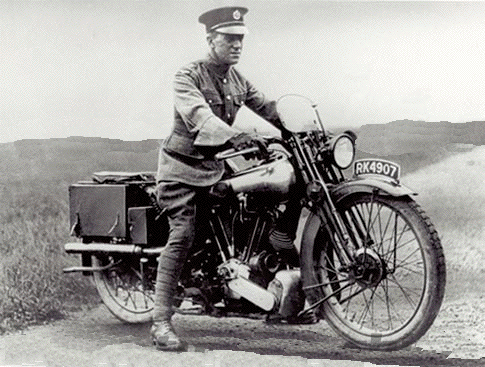
T.E. Lawrence on Brough Superior

Boa is a top-gear machine, as sweet in that as most single-cylinders in middle. I chug lordlily past the guard-room and through the speed limit at no more than sixteen. Round the bend, past the farm, and the way straightens. Now for it. The engine’s final development is fifty-two horse-power. A miracle that all this docile strength waits behind one tiny lever for the pleasure of my hand. Another bend: and I have the honour of one of England’ straightest and fastest roads. The burble of my exhaust unwound like a long cord
behind me. Soon my speed snapped it, and I heard only the cry of the wind which my battering head split and fended aside. The cry rose with my speed to a shriek: while the air’s coldness streamed like two jets of iced water into my dissolving eyes. I screwed them to slits, and focused my sight two hundred yards ahead of me on the empty mosaic of the tar’s gravelled undulations. Like arrows the tiny flies pricked my cheeks: and sometimes a heavier body, some house-fly or beetle, would crash into face or lips like a spent bullet. A glance at the speedometer: seventy-eight.
Boanerges is warming up. I pull the throttle right open, on the top of the slope, and we swoop flying across the dip, and up-down up-down the switchback beyond: the weighty machine launching itself like a projectile with a whirr of wheels into the air at the take-off of each rise, to land lurchingly with such a snatch of the driving chain as jerks my spine like a rictus.

The next mile of road was rough. I braced my feet into the rests, thrust with my arms, and clenched my knees on the tank til its rubber grips goggled under my thighs. Over the first pot-hole Boanerges screamed in surprise, its mud-guard bottoming with a yawp upon the tyre. Through the plunges of the next ten seconds I clung on, wedging my gloved hand in the throttle lever so that no bump should close it and spoil our speed. Then the bicycle wrenched sideways into three long ruts: it swayed dizzily, wagging its tail for thirty awful yards. Out came the clutch, the engine raced freely: Boa checked and straightened his head with a shake, as a Brough should.
The bad ground was past and on the new road our flight became birdlike. My head was blown out with air so that my ears had failed and we seemed to whirl soundlessly between the sun-gilt stubble fields. I dared, on a rise, to slow imperceptibly and glance sideways into the sky. There the Bif was, two hundred yards and more back. Play with the fellow? Why not? I slowed to ninety: signalled with my hand for him to overtake. Slowed ten more: sat up. Over he rattled. His passenger, a helmeted and goggled grin, hung out of the cock-pit to pass me the ‘Up
yer’ Raf randy greeting.

They were hoping I was a flash in the pan, giving them best. Open went my throttle again. Boa crept level, fifty feet below: held them: sailed ahead into the clean and lonely country. An approaching car pulled nearly into its ditch at the sight of our race. The Bif was zooming among the trees and telegraph poles, with my scurrying spot only eighty yards ahead. I gained though, gained steadily: was perhaps five miles an hour the faster. Down went my left hand to give the
engine two extra dollops of oil, for fear that something was running hot: but an overhead Jap twin, super-tuned like this one, would carry on to the moon and back, unfaltering.

We drew near the settlement. A long mile before the first houses I closed down and coasted to the cross-roads by the hospital. Bif caught up, banked, climbed and turned for home, waving to me as long as he was in sight. Fourteen miles from camp, we are, here: and fifteen minutes
since I left Tug and Dusty at the hut door.

I let in the clutch again, and eased Boanerges down the hill along the tram-lines through the dirty streets and up-hill to the aloof cathedral, where it stood in frigid perfection above the cowering close. No message of mercy in Lincoln. Our God is a jealous God: and man’s very best offering will fall disdainfully short of worthiness, in the sight of Saint Hugh and his angels.
Remigius, earthy old Remigius, looks with more charity on Boanerges. I stabled the steel magnificence of strength and speed at his west door and went in: to find the organist practising something slow and rhythmical, like a multiplication table in notes on the organ. The fretted, unsatisfying and unsatisfied lace-work of choir screen and spandrels drank in the main sound. Its surplus spilled thoughtfully into my ears.
By then my belly had forgotten its lunch, my eyes smarted and streamed. Out again, to sluice my head under the White Hart’s yard-pump. A cup of real chocolate and a muffin at the teashop: and Boa and I took the Newark road for the last hour of daylight. He ambles at forty-five and when roaring his utmost, surpasses the hundred. A skittish motor-bike with a touch of blood in it is better than all the riding animals on earth, because of its logical extension of our faculties, and the hint, the provocation, to excess conferred by its honeyed untiring smoothness. Because Boa loves me, he gives me five more miles of speed than a stranger would get from him.

At Nottingham I added sausages from my wholesaler to the bacon which I’d bought at Lincoln: bacon so nicely sliced that each rasher meant a penny. The solid pannier-bags behind the saddle took all this and at my next stop a (farm) took also a felt-hammocked box of fifteen eggs. Home by Sleaford, our squalid, purse-proud, local village. Its butcher had six penn’orth of dripping ready for me. For months have I been making my evening round a marketing, twice a week, riding a hundred miles for the joy of it and picking up the best food cheapest.

Friday, 20 July 2007

On the Ning Nang Nong -Spike Milligan

On the Ning Nang Nong
Where the Cows go Bong!
and the monkeys all say BOO!
There's a Nong Nang Ning
Where the trees go Ping!
And the tea pots jibber jabber joo.
On the Nong Ning Nang
All the mice go Clang
And you just can't catch 'em when they do!
So its Ning Nang Nong
Cows go Bong!
Nong Nang Ning
Trees go ping
Nong Ning Nang
The mice go Clang
What a noisy place to belong
is the Ning Nang Ning Nang Nong!!

Auguries of Innocence, by William Blake


To see a World in a Grain of Sand
And a Heaven in a Wild Flower,
Hold Infinity in the palm of your hand
And Eternity in an hour.


A Robin Red breast in a Cage
Puts all Heaven in a Rage.
A dove house fill'd with doves & Pigeons
Shudders Hell thro' all its regions.
A dog starv'd at his Master's Gate
Predicts the ruin of the State.
A Horse misus'd upon the Road
Calls to Heaven for Human blood.
Each outcry of the hunted Hare
A fibre from the Brain does tear.
A Skylark wounded in the wing,
A Cherubim does cease to sing.
The Game Cock clipp'd and arm'd for fight
Does the Rising Sun affright.
Every Wolf's & Lion's howl
Raises from Hell a Human Soul.
The wild deer, wand'ring here & there,
Keeps the Human Soul from Care.
The Lamb misus'd breeds public strife
And yet forgives the Butcher's Knife.
The Bat that flits at close of Eve
Has left the Brain that won't believe.
The Owl that calls upon the Night
Speaks the Unbeliever's fright.
He who shall hurt the little Wren
Shall never be belov'd by Men.
He who the Ox to wrath has mov'd
Shall never be by Woman lov'd.
The wanton Boy that kills the Fly
Shall feel the Spider's enmity.
He who torments the Chafer's sprite
Weaves a Bower in endless Night.
The Caterpillar on the Leaf
Repeats to thee thy Mother's grief.
Kill not the Moth nor Butterfly,
For the Last Judgement draweth nigh.
He who shall train the Horse to War
Shall never pass the Polar Bar.
The Beggar's Dog & Widow's Cat,
Feed them & thou wilt grow fat.
The Gnat that sings his Summer's song
Poison gets from Slander's tongue.
The poison of the Snake & Newt
Is the sweat of Envy's Foot.
The poison of the Honey Bee
Is the Artist's Jealousy.
The Prince's Robes & Beggars' Rags
Are Toadstools on the Miser's Bags.
A truth that's told with bad intent
Beats all the Lies you can invent.
It is right it should be so;
Man was made for Joy & Woe;
And when this we rightly know
Thro' the World we safely go.
Joy & Woe are woven fine,
A Clothing for the Soul divine;
Under every grief & pine
Runs a joy with silken twine.
The Babe is more than swaddling Bands;
Throughout all these Human Lands
Tools were made, & born were hands,
Every Farmer Understands.
Every Tear from Every Eye
Becomes a Babe in Eternity.
This is caught by Females bright
And return'd to its own delight.
The Bleat, the Bark, Bellow & Roar
Are Waves that Beat on Heaven's Shore.
The Babe that weeps the Rod beneath
Writes Revenge in realms of death.
The Beggar's Rags, fluttering in Air,
Does to Rags the Heavens tear.
The Soldier arm'd with Sword & Gun,
Palsied strikes the Summer's Sun.
The poor Man's Farthing is worth more
Than all the Gold on Afric's Shore.
One Mite wrung from the Labrer's hands
Shall buy & sell the Miser's lands:
Or, if protected from on high,
Does that whole Nation sell & buy.
He who mocks the Infant's Faith
Shall be mock'd in Age & Death.
He who shall teach the Child to Doubt
The rotting Grave shall ne'er get out.
He who respects the Infant's faith
Triumph's over Hell & Death.
The Child's Toys & the Old Man's Reasons
Are the Fruits of the Two seasons.
The Questioner, who sits so sly,
Shall never know how to Reply.
He who replies to words of Doubt
Doth put the Light of Knowledge out.
The Strongest Poison ever known
Came from Caesar's Laurel Crown.
Nought can deform the Human Race
Like the Armour's iron brace.
When Gold & Gems adorn the Plow
To peaceful Arts shall Envy Bow.
A Riddle or the Cricket's Cry
Is to Doubt a fit Reply.
The Emmet's Inch & Eagle's Mile
Make Lame Philosophy to smile.
He who Doubts from what he sees
Will ne'er believe, do what you Please.
If the Sun & Moon should doubt
They'd immediately Go out.
To be in a Passion you Good may do,
But no Good if a Passion is in you.
The Whore & Gambler, by the State
Licenc'd, build that Nation's Fate.
The Harlot's cry from Street to Street
Shall weave Old England's winding Sheet.
The Winner's Shout, the Loser's Curse,
Dance before dead England's Hearse.
Every Night & every Morn
Some to Misery are Born.
Every Morn & every Night
Some are Born to sweet Delight.
Some are Born to sweet Delight,
Some are born to Endless Night.
We are led to Believe a Lie
When we see not Thro' the Eye
Which was Born in a Night to Perish in a Night
When the Soul Slept in Beams of Light.
God Appears & God is Light
To those poor Souls who dwell in the Night,
But does a Human Form Display
To those who Dwell in Realms of day

Tuesday, 17 July 2007

Roads to Moscow -Al Stewart


They crossed over the border the hour before dawn,
Moving in lines through the day
Most of our planes were destroyed on the ground where they lay
Waiting for orders we held in the wood
Word from the front never came
By evening the sound of the gunfire was miles away

Softly we move through the shadows, slip away through the trees
Crossing their lines in the mist in the fields on our hands and our knees

All that I ever
Was able to see
The fire in the air, glowing red
Silhouetting the dust on the breeze

All summer they drove us back through the Ukraine
Smolensk and Viasma soon fell
By autumn we stood with backs to the town of Orel
Closer and closer to Moscow they come
Riding the wind like a bell
General Guderian stands at the crest of the hill

Winter brought with it the rains, oceans of mud filled the roads
Glueing the tracks of their tanks to the ground, while the skies filled with snow

All that I ever
Was able to see
The fire in the air, glowing red
Silhouetting the snow on the breeze


In the footsteps of Napoleon, the shadow figures stagger through the winter
Falling back before the gates of Moscow, standing in the wings like an avenger
And far away behind their lines, the partisans are stirring in the forest
Coming unexpectedly upon their outpost, growing like a promise
You'll never know, you'll never know, which way to turn, which way to look you'll never see us
As we're stealing through the blackness of the night you'll never know, you'll never hear us

And evening sings in a voice of amber, the dawn is surely coming
The morning road leads to Stalingrad, and the sky is softly humming

Two broken Tigers on fire in the night
Flicker their souls to the wind
We wait in the lines for the final approach to begin
It's been almost four years that I've carried your gun
At home, it will almost be spring
The flames of the Tigers are lighting the road to Berlin

I quickly move through the ruins that bow to the ground
The old men and children they send out to face us, they can't slow us down

All that I ever
Was able to see
The eyes of the city are opening
Now it's the end of a dream

I'm coming home, I'm coming home, now you can taste it in the wind the war is over
And I listen to the clicking of the train wheels as we roll across the border
And now they ask about the time that we were caught behind their lines and taken prisoner
They only held me for a day, a lucky break I say
They turn and listen closer
I'll never know, I'll never know, why I was taken from the line and all the others
to board a special train and journey deep into the heart of holy Russia

And it's cold and damp in the transit camp and the air is still and sullen
and the pale sun of october whispers the snows will soon be coming
And I wonder when, I'll be home again and the morning answers "Never".
The evening sighs and the steely, Russian skies go on,
forever...

Amelia:- it was just a false alarm.


Not the hexagram of the heavens, nor the strings of my guitar...more like a fraction of the pentagram of the heavens perhaps, But it's a sign. -I knew it was 'a sign'......
Yep. A sign that airliners will be important in my life soon.....................

Friday, 13 July 2007

Of Beauty, in Unexpected Places


These, as most of my photos, are taken with my phone, a Sony Ericsson K800i. (3.2 megapixel).
As the phone has no optical zoom, I tend to crop and tweak them a bit, using Google's free photomanagement suite, Picasa.
I recommend Picasa wholeheartedly. It's easy to use, and outperforms some other systems, it has Email tools and web albums built-in. And no, they don't pay me anything for this commendation.
The drawback to the phone is SonyEricsson's diabolical software interface, which took forever to install on my computer, and often crashes it. It has conflicts with other device drivers, and frequently crashes Windows XP Pro.
My previous Sony phone, a K750i had none of these problems... connect to the computer and the phone drives are mapped as external storage devices.
This one....
Well, sometimes it works okay.....
And when it's in 'Data Transfer Mode'... the phone part is disabled. How very annoying....

Waiting, at the hospital pharmacy, I read the walls.